

Prospective clients ask me a lot of questions about defamation.
Here’s a quick reference guide to the key elements of defamation.
The Key Elements Of Defamation
Defamation involves the communication of false and defamatory assertions of fact about you to one or more other people, harming your reputation.
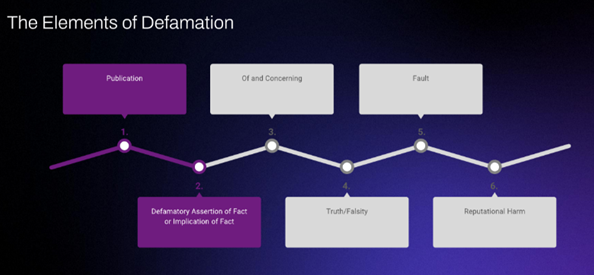
The key elements of defamation are:
- Publication – A communication that the wrongdoer made, directed, or took part in conveyed to one or more third parties.
- Defamatory assertion of fact or implication of fact – The assertion or implication must concern a fact or facts; pure opinion is expression protected by the First Amendment.
- Of and concerning – The assertion or implication must be about you.
- Truth/falsity – Only factual assertions or implications can be considered false; pure opinion cannot, by definition, be true or false.
- Fault – The wrongdoer is liable only if found at fault. If you are a public official or public figure, you must prove actual malice. “Actual malice” means the wrongdoer knew that the factual assertion is false or recklessly disregarded its falsity. But if you are a private individual, you must merely prove negligence.
- Reputational harm
Stay Tuned To Learn More About These Key Elements of Defamation
Defamation is a fascinating but complex area of the law. Stay tuned for more content to learn more about these key elements of defamation.
The Law Firm of Mark A. Sereni, PLLC
The Law Firm of Mark A. Sereni, PLLC is a full-service law firm in Media, Delaware County, Pennsylvania. We strive to help people, businesses and institutions throughout Southeastern Pennsylvania solve legal problems – and even prevent legal problems before they occur. To learn more about the full range of our specific practice areas, please visit www.markaserenilaw.com or contact Mark A. Sereni, Esquire at 610-565-5700 or at msereni@markaserenilaw.com.
DISCLAIMER
The information that our blogs provide does not, and is not intended to, constitute legal advice; instead, all information is for general informational purposes only. Information in our blogs may not constitute the most up-to-date information. Readers of our blogs should contact a qualified attorney to obtain legal advice with respect to any particular legal matter. No reader should act or refrain from acting on the basis of any information in our blogs without first seeking legal advice from a qualified attorney. Only the reader’s own attorney can provide assurances that the information contained in our blogs – and any interpretation of it – is applicable or appropriate to the reader’s particular legal issue. Use of, and access to, the information in our blogs does not create, and is not intended to create, an attorney-client relationship between the reader and our law firm or our blog authors.
